Research

Research

Geospatial computer vision: how to represent places so networks can learn from them, and how to search the planet without encoding all of it. Earlier work in neuroscience instrumentation, clinical data and automotive radar.

01Publications

Google Scholar
ECCV
2026

Tessellating the Earth: Learnable Spherical Voronoi Partitions for Location Encoding

Daniel Cher, Hamza Iqbal, Eric Xing, Brian Wei, Nathan Jacobs

Location encoders turn a latitude–longitude pair into a learned representation, but most project coordinates onto a fixed basis and spend as much capacity on open ocean as on a growing city. TTE builds the encoder from a learnable spherical Voronoi partition: each site carries its own embedding and migrates during training toward the areas that matter, end to end and fully differentiable. A small vocabulary of shared global semantic tokens, distilled from satellite imagery, lets distant sites with similar environments share meaning. TTE sets a new state of the art across geospatial classification and regression benchmarks and is the strongest geographic prior for fine-grained species classification on iNaturalist-2018.
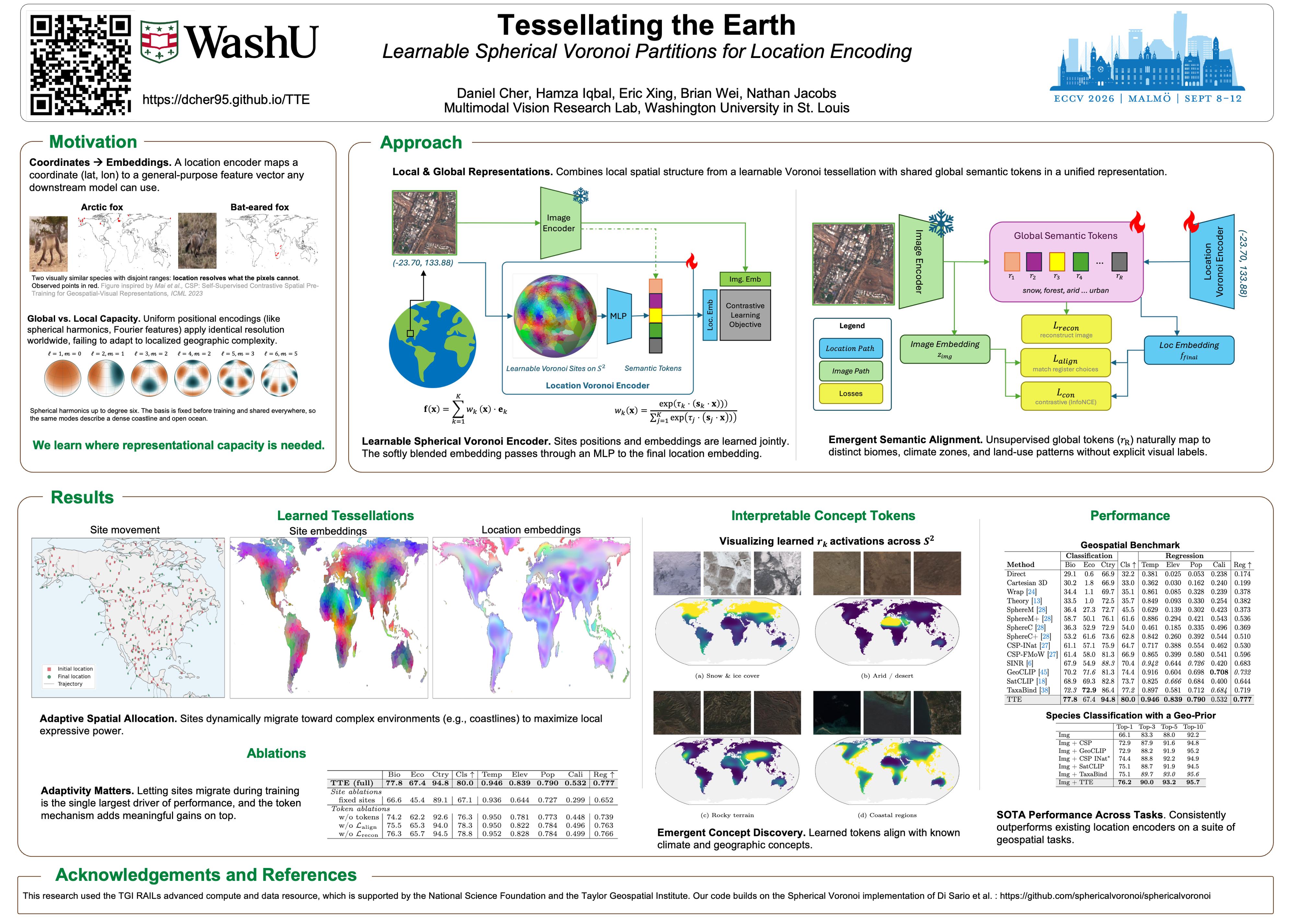
ECCV 2026 poster for Tessellating the Earth
Under
review

Efficient retrieval for planet-scale image geolocalization

Hamza Iqbal and collaborators at MVRL. Title and author list withheld during double-blind review.

Image geolocalization by retrieval usually means encoding a query against every tile of a planet-scale gallery. This work organizes the gallery hierarchically and learns which regions are worth refining, so most of the gallery is never encoded at all. It matches exhaustive search at a fraction of the encoding cost and extends to object-level queries. Under review; name, code and details after the decision.

02Talks & posters

  • A Low-cost, Open-source Control and Timing System for Training Animals on Behavioral Tasks. Poster, Society for Neuroscience annual meeting (SfN 2019), Chicago, IL.
  • The same work as a poster at the Annual Biomedical Research Conference for Minority Students (ABRCMS 2019), Anaheim, CA.
  • Pilot analysis of participant retention in Alzheimer’s disease studies (Knight ADRC, Stark Lab). IAGG 2017 World Congress of Gerontology and Geriatrics.

03Research experience

Research Associate · Multimodal Vision Research Lab, Washington University in St. Louis
Nov 2025 – present

Joined as a graduate researcher in November 2025 and stayed on as a research associate after finishing the M.S. Advisor: Nathan Jacobs.

  • Co-authored Tessellating the Earth (ECCV 2026), a location encoder built from learnable spherical Voronoi partitions.
  • Lead a project on efficient retrieval for planet-scale image geolocalization: hierarchical search over a multiresolution gallery that matches exhaustive retrieval at a fraction of the encoding cost. Paper under review.
  • Train contrastive vision transformers on large-scale satellite imagery and run distributed experiments on SLURM clusters with PyTorch Lightning.
Research Assistant & Data Manager · Stark Lab, Program in Occupational Therapy, WashU School of Medicine
Jan 2021 – Jan 2022
  • Managed clinical datasets for fall-prevention and Alzheimer’s studies with the Knight ADRC; cleaned and structured 5,000+ participant records, including unstructured clinical notes, for cohort selection.
  • Statistical analysis of health-outcome and time-series data in Python, MATLAB and SPSS; built data dictionaries and merged data across instruments and study arms; added REDCap safeguards after finding structural data-entry issues.
Research Fellow · Ozden Lab, behavioral neuroscience, University of Missouri
May 2019 – May 2021
  • Designed and built a low-cost, open-source control and timing system for behavioral experiments (Python, C, Arduino, custom PCB in Eagle): 85% cheaper and 87.5% lower latency than the commercial alternative.
  • Analyzed 3+ TB of mouse EEG recordings in the frequency domain toward a non-invasive deep-brain-stimulation approach.
Research Assistant · Milescu Lab, computational neuroscience, University of Missouri
Aug 2017 – Apr 2019
  • Maintained and extended QuB, the lab’s Delphi-based ion-channel simulation software; ran electrophysiology experiments with two-photon imaging.
  • Built a low-cost multispectral imaging rig, prototyped lab tools in CAD, and migrated the lab website to Google Cloud.
Summer Research Student (STARS) · Stark Lab, WashU School of Medicine
May – Aug 2016
  • Studied retention in Knight ADRC studies: cleaned a 5,000+ participant dataset and tested the link between travel distance and retention with the Google Maps API and regression. Presented at IAGG 2017.

04Teaching

Teaching Assistant, CSE 4470: Automata & Theory of Computation · Washington University in St. Louis
Spring 2026

Grading, weekly office hours and student support for the undergraduate theory of computation course (instructor: Jeremy Buhler).